For those HSC students studying Business Studies here is an interview with Qantas CEO (Alan Joyce) from the 7:30 report on Thursday night providing the latest statistics and insights into their performance over the last 12 months. Lots of good material for Operations and Finance for your case study section of the paper. Click on Alan Joyce below to be taken to the interview. Transcript of the interview is shown below.
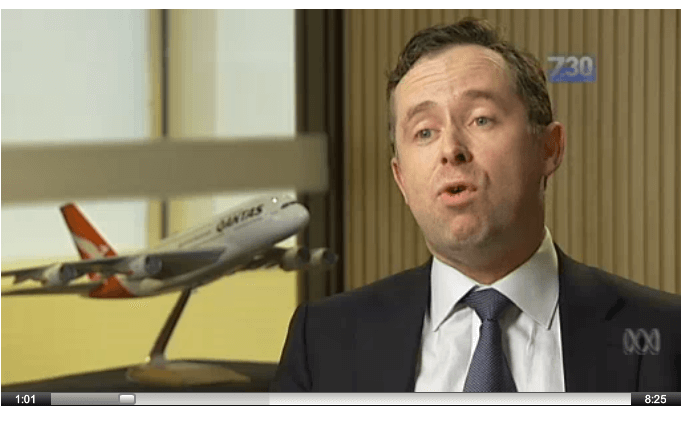
Despite the scale of Qantas’ losses, Chief Executive Alan Joyce says it’s as bad as it will get for the national carrier and it will post a profit this financial year.
Transcript
CHRIS UHLMANN, PRESENTER: Qantas chief executive Alan Joyce is confident that this is as bad as it will get for the national carrier and that it will post a profit in the first half of this financial year. I spoke with him at Qantas’ head office in Sydney.
Alan Joyce, welcome to 7.30.
ALAN JOYCE, CEO, QANTAS: Thanks, Chris. Good to be here.
CHRIS UHLMANN: Now you’ve just posted the biggest corporate loss by Qantas in its history. Since you became CEO, the share price is down 40 per cent, you lost 2,500 since February, you’re going to lose 4,000 by the end of the year. Why shouldn’t you go too?
ALAN JOYCE: Well, the results that we had last year were driven by two major factors. One of them was fuel costs, which were a record tie at $253 million on the previous year, and the other was the oversupply of capacity, both from international and domestic capacity, which cost us over $500 million, so the underlying losses of $646 million were as a result of the environment. Now what we’re doing, what I’m doing is making sure that we turn this business around, implement a transformation program that’s going to save over $2 billion over the next few years. And we did give an outlook statement today which says that we believe it is paying dividends, the business is turning the corner and we believe the business will be back in profitability for the first half of this year.
CHRIS UHLMANN: But you’re not just a hostage to circumstances, are you, because when it comes to oversupply, you helped create those headwinds because you put on every – two seats for every one that Virgin put on.
ALAN JOYCE: So let’s go through them individually in the markets. The biggest oversupply problem we had is international, where we’ve had a 9.5 per cent capacity growth by international carriers. A lot of those carriers are now losing money and they’ve also said that they are pulling back on the market. We had AirAsia X with Singapore Airlines, Virgin Atlantic pulling out of the market because of the oversupply and capacity …
CHRIS UHLMANN: Domestically, though, I’m talking about.
ALAN JOYCE: So, I’ll come to domestic. So internationally, therefore, we’ve seen a big hit to our profitability as a consequence of that. In the domestic market, the big part of what we offer to the corporate market is the network, the frequency that we offer the corporate market. It’s really key to the profitability of Qantas domestic, it’s part of the product attributes, like Apple have a good camera on – good camera on their phones. For us, that network of frequency is (inaudible).
CHRIS UHLMANN: How much money did you lose by chasing a 65 per cent market share, putting on 7.1 million seats over three years?
ALAN JOYCE: Well, what we did, to be very clear, is we maintained our competitive advantage with frequency of network and our domestic business is still making money. Our domestic business …
CHRIS UHLMANN: And how expensive was it, though? How much did it cost you?
ALAN JOYCE: What it cost us – what it maintained for us was the corporate market and we maintained 80 per cent of the corporate market, we’re keeping – winning corporate accounts and retaining corporate accounts, and in the long term, that’s what’s really important for Qantas, is to maintain that corporate presence.
CHRIS UHLMANN: But you’ve suspended that war now, haven’t you?
ALAN JOYCE: So what we’ve done is say that because of the environment which we’re operating in, with the resource sector being weak, the Government sector being weak and we have frozen capacity for the – these six months, and what’s happen is our competitor is also – who’s losing money, has taken significant amount of capacity out of the market and we’ve gotten back to stability in the marketplace, and we always wanted stability in the marketplace, but Qantas, within this period of time, needed to maintain its advantage of frequency and network, which has paid us dividends in the corporate market.
CHRIS UHLMANN: What about something else that was in your control, the expansion of Jetstar into Asia – that’s also been a costly venture, another one that you’ve suspended the expansion of?
ALAN JOYCE: So let’s be clear on that. We’ve seen a $20 million worsening of the performance of the Jetstar associates in Asia, mainly driven for the startup costs associated with Jetstar Japan. Anybody looking at the aviation industry said, “That is going to be a phenomenal business,” and when you set up a business like that, it’s a huge growth opportunity for us, we have 46 per cent economic interests in it, we have some major players as other investments in that business, it’s the third-largest economy in the world and we now have the fourth-largest carrier operating in that route. It’s making great inroads in terms of the low-cost market, nearly 60 per cent of that market, and this is an Australian brand. It will be a great business for the Qantas Group into the future, but there’s an investment today that we’re making for that return and that growth in the future.
CHRIS UHLMANN: Sure, but you’ve been CEO for six years now. How are we to judge your performance if not by profitability and share price, and by both of those measures, you’re not doing well?
ALAN JOYCE: So what we have is we’ve had an airline industry around the world that’s gone through different restructuring at different stages. How you judge my performance is delivering on the transformation program for Qantas to be able to cope with the environment that we’re dealing with, high fuel price, which is out of our control, $253 million. We’re compensating that for the transformation program. The competitive dynamic that we’ve been facing for a few years, which is rationalising, and now turning this business back into profits. Also judge me on the fact that we’re maintaining the corporate market. Also judge me on the fact that we’re hitting record high customer satisfaction levels for Qantas. Also judge me on the fact that we’re renewing the Qantas fleet, the youngest it’s been in 20 years – that’s a big renewal we’ve done over the last five years, that’s a big investment to get this business positioned for the future.
CHRIS UHLMANN: But on the domestic market, you are losing passengers against last year.
ALAN JOYCE: So, the passenger numbers are down because the market is weak. We have 80 per cent of the corporate market. So the resource sector, for example in WA, is down 16 per cent because the mining companies and their suppliers are all cutting back. Government traffic is down by 12 per cent ’cause the governments are cutting back on expenditure, and because we have 80 per cent of the corporate market, we get hit by that more than anybody else. So we’ve a weak market environment, but we are coping with that because we’re transforming the cost base of Qantas domestic.
CHRIS UHLMANN: Is it not reasonable though if I’m an investor to say, “What I want to see is profitability and a high share price”?
ALAN JOYCE: Yeah, and the investors today reacted positively to our announcement, despite the losses, ’cause our share price – because they believe that we’re turning …
CHRIS UHLMANN: And over time while you’ve been CEO, it’s gone down 40 per cent. So if you’re going to use the market as a measure, then the market over time has measured you and marked you a fail.
ALAN JOYCE: So what you have, though, is that you have, as we’ve said, environmental factors like high fuel price and the capacity levels that’s impacted the business. What shareholders and our board are focusing in on is us delivering on the transformation program and the market today saw the benefits of that transformation program coming through in the second half of last year and they know that we’re committed to delivering on that transformation going forward and they see light at the end of the tunnel because they see this business turning and going back into profitability for the first half of financial year ’15.
CHRIS UHLMANN: Well the tunnel has been long. Tell us when we get to the light. What do you see for the future of Qantas?
ALAN JOYCE: So that’s exactly what we’ve said today in our outlook statement – the first time we’ve given an outlook statement for some time – and we said for the first half of financial year 15, this is the six months that we’re in today, we expect the business to return to profit, subject to factors outside of our control. We do believe that we are seeing the transformation program delivering real benefits and our cost disadvantage is narrowing. We are seeing stability in the market, with less capacity being added internationally and domestic, and that’s good for the yield environment which we’re operating in. And as I said, we’re seeing the Qantas service level reaching record levels. There’s no better time to fly in Qantas than today. Record levels in all parts of our business and we’re seeing our businesses in Asia showing signs of improvement and growth.
CHRIS UHLMANN: Alright. Finally, then, Alan Joyce, set us some markers by which we can judge you. In a year’s time, what should we see to say either we mark you a pass or a fail on the running of Qantas?
ALAN JOYCE: So what we’ve set up is very clear measures to our shareholders and to our owners, which is that we will deliver on the transformation program we’ve outlined, which is delivering $600 million in benefits in the current financial year on top of the $200 million that we delivered last year. To deliver completely over the next three years the $2 billion program that we’ve set out, to continue to deliver on the record customer satisfactions that we have for the business, to continue to deliver on the investments that we’re making in new aircraft and new product and delivering excellent customer service to our customers around the globe. They’re all parts of what we’ve committed to our customers, to the sharemarket, in terms of the delivery for the management.
CHRIS UHLMANN: Alan Joyce, thank you.
ALAN JOYCE: Thank you, Chris.